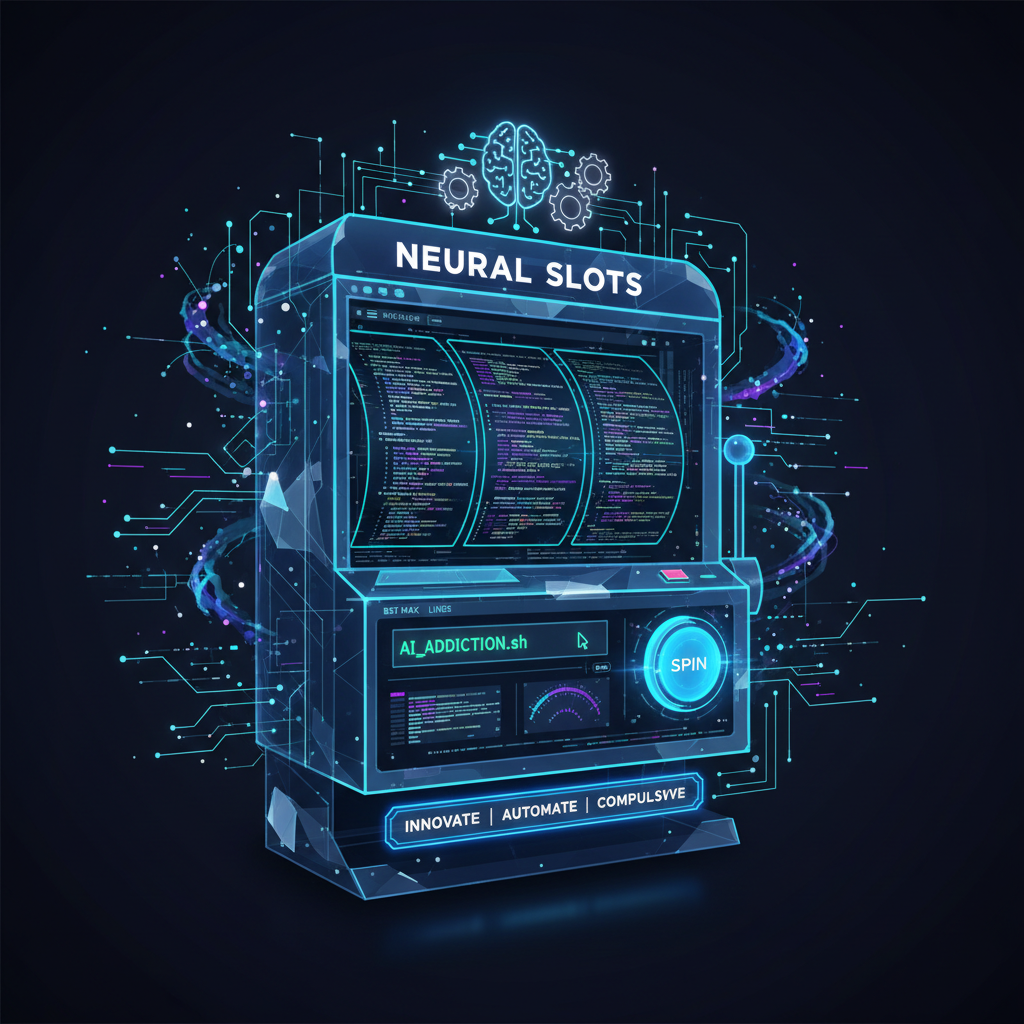
The Slot Machine in Your IDE: How AI Coding Tools Exploit Addiction Mechanics
The Slot Machine in Your IDE
A slot machine gives you unpredictable rewards. You pull a lever. Symbols spin. Sometimes you win. Mostly you don’t. But the almost-win — two cherries and a blank — feels more compelling than a clean loss. So you pull again.
Now replace the lever with Tab. Replace the symbols with streaming tokens. Replace “two cherries” with code that passes 11 out of 12 tests.
You’re pressing Enter. The behavioral patterns are analogous.
Six mechanisms from addiction research may parallel how AI coding tools operate. Similar behavioral patterns. Analogous cognitive traps. The same kinds of loops that keep gamblers at machines for 14-hour sessions.
Not anti-AI. Pro-awareness.
Mechanism 1: Variable Ratio Reinforcement
Slot machines pay out on a variable ratio schedule. You never know which pull will hit. B.F. Skinner demonstrated this in the 1950s. Every casino on Earth still runs on it.
AI code generation works the same way. Send a prompt. Sometimes you get a perfect implementation. Sometimes you get hallucinated garbage. Sometimes you get something close but subtly wrong in three places.
That unpredictability drives compulsion.
If every response were perfect, you’d use the tool and close it. If every response were garbage, you’d stop. The random alternation between brilliant and broken makes you type “try again” at 2 AM.
Researchers call this the variable ratio reinforcement schedule. It produces the highest response rates of any reinforcement pattern ever studied. It also creates the greatest resistance to extinction. Rats press a lever until they collapse. Developers press Enter until the sun comes up.
Mechanism 2: The Near-Miss Effect
In slot machines, a near-miss produces greater arousal than a clean loss. Two matching symbols and one off. Brain imaging studies in gambling suggest near-misses activate reward circuitry in ways that resemble actual wins. The machine didn’t pay out. Your brain processed it as “almost won.”
In AI coding, the near-miss is code that almost works.
11 of 12 tests pass. The function runs but returns a wrong value. The component renders but breaks on one edge case. A total miss — syntax errors everywhere — lets you step back. A near-miss triggers the urge to try one more time. You’re so close.
This maps to our quiz dimension Session Escalation: “When code ‘almost works’ (1-2 failing tests), I feel a strong urge to try again immediately.”
One more prompt. One small tweak. Just fix that last test. You’re chasing the near-miss like a gambler chasing the almost-jackpot. The distance between “almost works” and “works” feels small. It rarely is.
Mechanism 3: Loss Aversion and Sunk Cost
You’ve debugged this AI-generated function for 90 minutes. It still doesn’t work. The rational move: step back, rethink, maybe write it by hand. But you’ve already invested 90 minutes.
Loss aversion makes you weigh those 90 minutes more heavily than the time you’d save by stopping. Kahneman and Tversky documented this as one of the strongest cognitive biases. The sunk cost fallacy locks you in.
Gamblers call this being “stuck.” They can’t leave because they’re down. Leaving crystallizes the loss. Staying preserves the possibility of recovery.
Developers do the same thing. You can’t abandon the session. You’ve sunk three hours into it. Closing the terminal means those hours produced nothing. So you stay. One more prompt. One more approach. The session ends at dinner instead of lunch.
This is our Loss of Control dimension. The quiz asks: “I often say ‘just one more prompt’ and end up continuing for much longer.” That “just one more” isn’t a plan. It’s loss aversion wearing a productivity costume.
Mechanism 4: Dark Flow
Csikszentmihalyi described flow as full immersion with intrinsic reward. Athletes experience it. Musicians experience it. Developers know it well.
Addiction researchers identified a variant: dark flow. Same absorption. Same time distortion. Same loss of self-awareness. Different outcome. You’re fully immersed but not in control. You’re not choosing to continue. You’ve forgotten that stopping is an option.
AI coding tools may be dark flow machines. The feedback loop is instant. Prompt, response, evaluate, prompt again. No compilation wait. No deployment delay. The cycle spins as fast as you can read. Hours disappear. You skip lunch. Your partner goes to bed without you.
Dark flow feels like productivity. That’s what makes it dangerous. You’re not scrolling social media — you’re working. The output looks like work. But if you couldn’t stop even when you wanted to, that’s not flow. That’s compulsion.
Our Dark Flow dimension measures exactly this: “I lose track of time during AI coding sessions and am surprised how much time has passed” and “During intense AI coding, I forget to eat, drink water, or use the bathroom.”
The line between flow and dark flow is a single question: could you stop right now if someone asked you to?
Mechanism 5: Operational Dependency
Gamblers show withdrawal symptoms when separated from their environment. Anxiety. Irritability. Restless inability to focus. No chemical leaves their body. It’s behavioral withdrawal — the absence of a stimulus their brain learned to depend on.
Rate limits hit at 3 PM. Your AI tool goes down. What happens?
If you switch to manual coding and keep working, you’re fine. If you feel anxious, check the status page every two minutes, and can’t concentrate — that’s withdrawal. Not the dramatic kind. The quiet kind that looks like a workflow disruption but feels like something was taken from you.
Our quiz calls this Operational Dependency: “When my AI tool is unavailable (outage, rate limit), I feel anxious or unable to work.”
The deeper signal: “I have reorganized my day or cancelled plans because my AI tool became available or a session was going well.” You cancelled dinner because tokens started flowing again. Sit with that.
Mechanism 6: Anticipation Shift
The strangest mechanism. In advanced gambling addiction, the reward shifts. The gambler no longer plays to win money. They play for the anticipation — the moment between pulling the lever and seeing the result. The spin becomes the drug. The outcome is almost irrelevant.
Watch yourself when streaming output appears. Character by character. Line by line. Do you feel tension while it generates? A small rush as code takes shape? Is the watching more engaging than the result?
If the streaming output excites you more than the finished code, your reward shifted. You’re not using the tool for its output. You’re using it for the spin.
Our Anticipation Shift dimension asks: “I find the streaming output (watching code appear line by line) more exciting than the final result” and “I sometimes run prompts just to see what the AI will generate, without a clear goal.”
Running prompts without a goal is pulling the lever without betting. You’re there for the motion.
The Uncomfortable Sum
Six mechanisms. Each documented in peer-reviewed addiction research. Each with observable parallels in AI coding tools.
None were designed with malicious intent. Variable output quality is a limitation, not a feature. Near-misses happen because generation is probabilistic. Streaming output exists because latency would be worse without it. The addictive patterns are emergent, not engineered.
That doesn’t make them less real.
A slot machine doesn’t need to be “designed to be addictive.” It just needs to produce conditions that behavioral research associates with compulsive use. The mechanism doesn’t care about intent. The behavioral pattern doesn’t check whether the designer meant to create it.
Hygiene, Not Abstinence
Nobody tells you to stop sleeping. They tell you to practice sleep hygiene. Consistent schedule. Dark room. No screens before bed. Specific behaviors that make sleep healthy instead of disordered.
AI tool use needs the same approach. Not abstinence. Hygiene.
Session timers. Set a hard 90-minute boundary before you start. When the timer fires, you stop. Not “after this prompt.” Now. Internal boundaries fail under dark flow. Use a physical timer, not a dismissible notification.
Pre-commit pause. Before accepting AI-generated code, close the chat. Read the code without the AI context. Ask: “Would I accept this in a code review from a junior?” If you’re rubber-stamping output to keep the session moving, you’re feeding the loop.
The manual check. Once per day, write something without AI. A function. A component. A test. The purpose is recalibration — maintaining the confidence that you can work without the tool. If this produces anxiety, that’s data.
Output journaling. After each AI session, note three things. How long did you plan to work? How long did you actually work? What triggered the overrun? Patterns emerge fast.
Near-miss protocol. When code almost works, pause before the next prompt. Read the failing test. Understand why it fails. Then decide: prompt again or fix manually. The pause breaks the near-miss-to-retry reflex.
Environment design. Remove streaming output if your tool allows it. Reduce the visual spectacle. The less it feels like a slot machine, the less it behaves like one in your brain.
Where Do You Stand?
We built a self-check tool that measures all six dimensions. 14 questions. 3 minutes. Anonymous — no email, no account, no PII.
It won’t diagnose you. It gives you a mirror — a structured reflection on patterns you haven’t noticed.
Six dimensions: Loss of Control, Session Escalation, Dark Flow, Operational Dependency, Negative Consequences, and Anticipation Shift. Each scored independently. You see where your patterns concentrate.
Take the AI Work Patterns Self-Check
If the results surprise you, good. Surprise means you spotted a pattern you weren’t tracking. Awareness is the first step of hygiene.
These tools are powerful. They will get more powerful. The developers who thrive long-term won’t use AI the most. They’ll use it with the most awareness.
The slot machine doesn’t care about your deadlines. Your reward system doesn’t care about your sprint goals. But you can learn to see the mechanics. Once you see them, they lose most of their power.
OnTilt is a research project studying behavioral patterns in AI-assisted work. The quiz is a self-check tool, not a diagnostic instrument. Built on peer-reviewed research from gambling studies, behavioral addiction, and human-computer interaction. Read more on our About page.